How to show up on ChatGPT, Gemini, and Claude: a guide for small businesses
A guide for small businesses
How to show up on ChatGPT, Gemini, and Claude
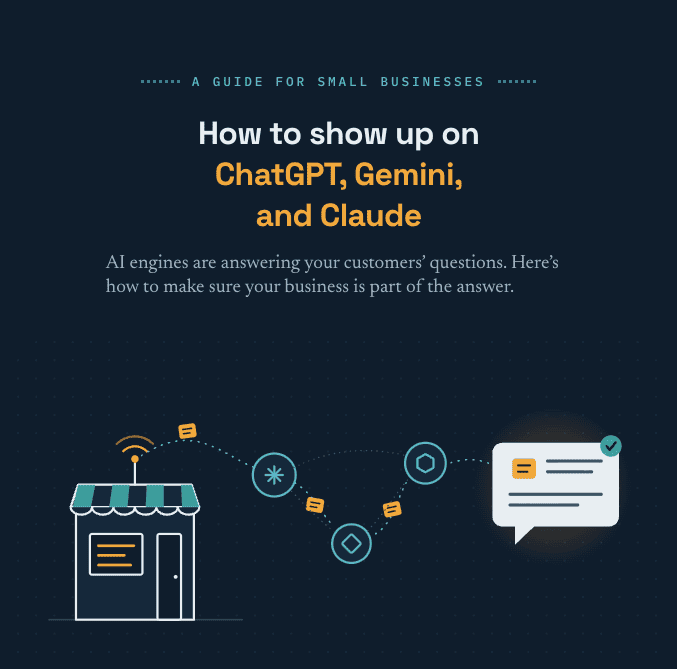
AI engines are answering your customers’ questions. Here’s how to make sure your business is part of the answer.
The one thing you have to understand about showing up on AI engines is that the results come from machines talking to machines.
Your final audience is always human — and your website content should always be written for them — but surfacing your website in AI results is a different game.
So what’s the easiest, most efficient way for these new AI engines to surface your content? It happens when the engine understands what your content is, how it answers the user’s question, and why it’s the best fit for that audience.
That means a lot of the work gets done under the hood. It’s no longer just about writing lots of compelling, long-form content — it’s about the engines knowing you have what they’re looking for.
Formatting your content correctly, being specific, providing high-value information, telling the AI engine what you’re writing about, and answering the question directly are all ingredients that push you above the rest.
But it’s not just that. You also need a track record of trust and authority. Think citations, not just content.
Engines trust businesses that other sources vouch for.
Say you’re an HVAC company that answers questions about the best ways to weatherproof a home. If your website consistently shows up for a variety of HVAC-related questions, delivers real value to clients through authoritative advice, and is written so people get answers quickly and thoroughly — you’re on the right track.
Easy tactics you can start today
You don’t need a big budget or an agency to get started. Here are simple things any small business owner can do:
What an AI-friendly page looks like, at a glance.
Answer the question in the first two sentences
AI engines pull direct answers, not slow build-ups. Lead with the answer, then explain the details below it.
Write headings the way people actually ask
“How much does furnace repair cost in Brooklyn?” beats “Our Services.” Question-style headings map directly to the questions AI engines are trying to answer.
Add an FAQ section to your key pages
FAQs are the easiest format for machines to read: one clear question, one clear answer. Base them on the real questions your customers ask you.
Use structured data (schema markup)
This is code that tells engines exactly what your page is — a local business, a service, an FAQ. Most website builders like WordPress, Squarespace, and Wix have plugins or built-in settings that handle this for you.
Keep your business info identical everywhere
Your name, services, and location should match exactly across your website, Google Business Profile, Yelp, and every directory. Inconsistency confuses machines and erodes trust.
Be specific with real details
Prices, timelines, service areas, years in business. “We respond within 24 hours anywhere in Queens” is far more useful to an AI engine than “fast, reliable service.”
Get mentioned on other sites
Reviews, local news features, industry directories, community pages. Remember: citations, not just content. Engines trust businesses that other sources vouch for.
Keep your content current
Update your pages regularly and make sure dates, prices, and offerings reflect reality. Engines favor fresh, accurate information.
Ask the engines about your business
Type your services into ChatGPT, Gemini, and Claude and see what comes back. It’s the fastest way to find out how machines currently see you — and what’s missing.


 476 Views