How To Measure Your AI Search Visibility: Is Chat GPT Recommending Your Business?

Quick Answer
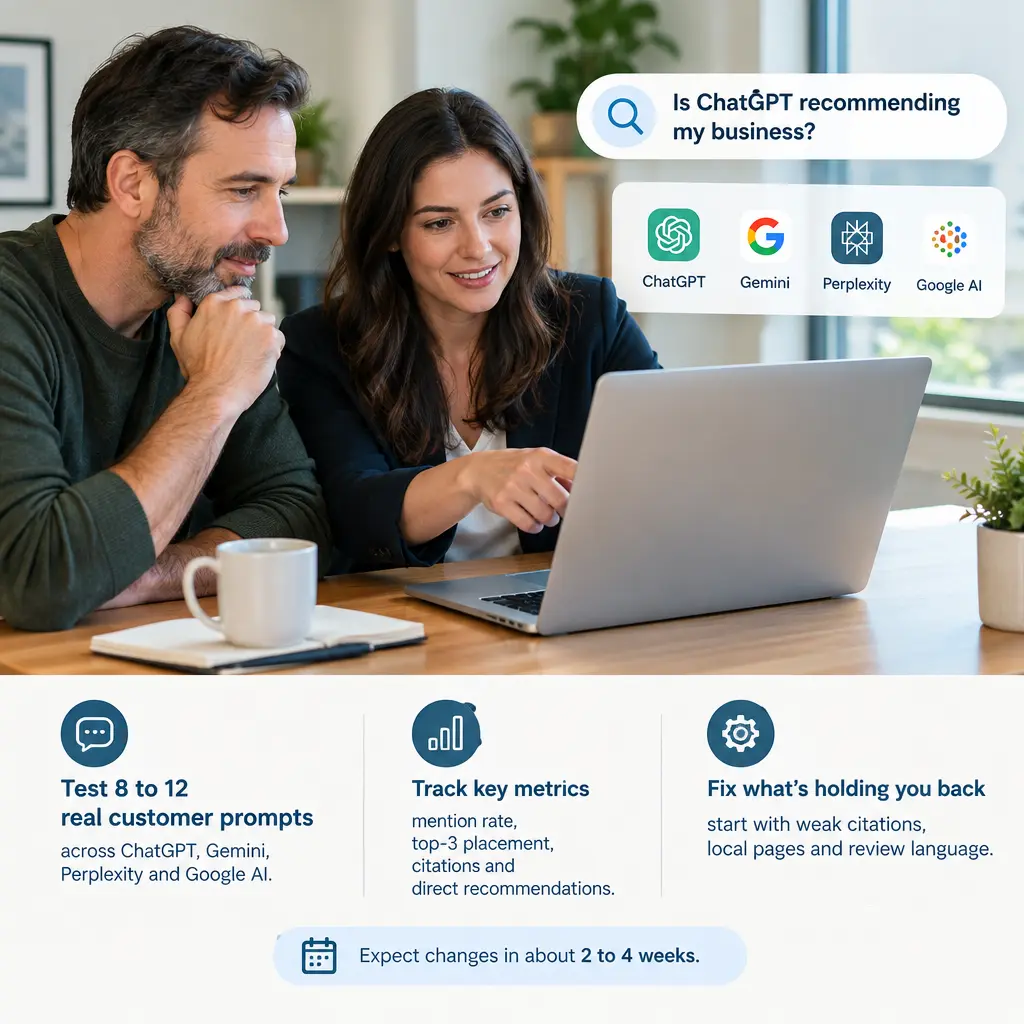
Measure AI search visibility by checking whether your business is mentioned, cited, or recommended in ChatGPT, Gemini, Perplexity, and Google AI answers across 8 to 12 customer-style prompts, run several times each, then repeat the same test monthly to track changes.
If you want a real answer to whether AI systems are sending customers your way, stop guessing and start scoring. The useful metric is not vanity traffic; it is whether your business shows up in the first visible answer, with a source attached, for the prompts real buyers would use.
A practical audit takes about 60 to 90 minutes the first time. After that, the same check usually takes 20 to 30 minutes a month, because you are repeating the same prompts and comparing results instead of starting from scratch each time. Platforms like Fiore AI, an AI marketing intelligence platform that learns your business, brand, audience, goals, and performance history to give personalized recommendations and show you what to do next, can track this alongside the rest of your marketing.
Pro Tip
Use the same 8 to 12 prompts every month. That gives you a clean before-and-after comparison, which matters more than any single good or bad result.
What Should You Measure First?
Start with four numbers: appearance rate, top-3 rate, citation rate, and recommendation rate. Appearance rate tells you how often the business is mentioned at all, top-3 rate tells you whether it appears in the first visible answer set, and citation rate tells you whether the system points to your site, profile, or another source. Recommendation rate tells you whether the answer actually tells the buyer to choose or contact you.
Those four numbers separate exposure from persuasion. A business can appear often and still lose customers if the answer never recommends it, never links to it, or buries it below competitors.
How Do You Test Whether AI Recommends Your Business?
Ask buying-intent questions, not brand questions. Prompts like “best emergency HVAC repair near me” or “who installs hardwood floors in Austin” show whether AI systems can connect your business to a real customer need, not just recognize your name.
Then run those prompts through a repeatable audit, so you measure a pattern instead of a single answer. If an answer cites a competitor with better service pages or clearer location language, that is a signal to fix your own content, not a reason to ignore the result.
A Repeatable AI Visibility Audit
Write 8 to 12 prompts based on what customers actually ask on calls, in emails, and in reviews. Mix service, problem, and location questions, such as “who fixes a leaking water heater in Pasadena.” Leave your business name out.
Run every prompt in ChatGPT, Perplexity, Google AI results, and Gemini. Use a fresh session and the same location each time, and run each prompt 3 times per platform.
For every run, log the date, platform, whether your business was mentioned, its position, which source was cited, and which competitors were named.
Your appearance rate is the number of runs that mention you divided by total runs. 7 mentions across 30 runs tells you more than one good answer.
Re-run the same prompts monthly, or every 2 weeks after a major change. Judge progress over 3 months of trend, not one check.
Why one answer is not a measure
AI answers are generated fresh each time. The same question can name different businesses minutes apart, depending on the platform, the user’s location, the exact wording, and model updates. A single answer is a sample of one. Your visibility is the rate across many runs and the trend across months.
How Do You Score the Results?
Use a simple scoring model: for each run, give 1 point for a mention, 1 for a top-3 position, 1 for a citation, and 1 for a recommendation. A business that appears in 6 of 10 prompts, with citations in 4 and recommendations in 3, is in a much better spot than a business that appears in 8 but is never chosen.
This works because AI systems can expose you without persuading the buyer. A strong score means the system not only knows your business exists but is willing to surface it as a credible choice.
| Metric | What It Means | Starting Goal |
|---|---|---|
| Appearance rate | Business is mentioned at all | 5 to 8 of 10 prompts |
| Top-3 rate | Business appears in the first visible answer set | 4 to 6 of 10 prompts |
| Citation rate | Answer links to your site or profile | 3 to 5 of 10 prompts |
| Recommendation rate | Model tells the user to contact or choose you | 2 to 4 of 10 prompts |
Starting goals are rules of thumb. Adjust them for how competitive your market is.
Warning
Do not test only your business name. Brand-only prompts prove almost nothing, because the system already knows you exist. Use customer-intent prompts or you will overestimate your visibility.
What Data Actually Moves the Needle?
The fastest-moving signals are a complete Google Business Profile, service pages that name the city and service directly, and reviews that repeat the phrases your customers actually use. A page about “roof repair” is weaker than a page about “emergency roof leak repair in Phoenix” because the second version gives the model far more context.
Structured data helps too, especially LocalBusiness schema and FAQ Page schema. Google now shows FAQ rich results only for a limited set of sites, but the markup still helps systems read your page. Clean NAP consistency matters as well, meaning your name, address, and phone must match across your website, profile, and directories. If “Suite 200” appears on one source and “Ste 200” on another, fix it everywhere.
Common Mistakes That Make the Numbers Lie
The first mistake is checking once and treating that result as truth, which the audit above is built to prevent.
The second mistake is ignoring competitors. Compare your results against 3 to 5 businesses in the same market, because a decent-looking answer for you may still be worse than what the buyer sees for a rival. That comparison shows whether your problem is visibility, credibility, or both.
What Should You Fix If the Scores Are Weak?
If your mention rate is under 50 percent, fix citations and category clarity first. If your mention rate is fine but your recommendation rate is weak, strengthen proof with 10 to 20 recent reviews, one service page per core service, and price ranges where you can publish them honestly.
Directionally, many small businesses see movement after 2 to 4 weeks, because AI systems need time to recrawl pages and reweight signals. Faster gains usually come from tightening the homepage headline, cleaning up the Google Business Profile, and making sure the local service pages match the questions customers ask.
What Is a Good Visibility Score for a Local Business?
A useful target is appearing in 5 to 8 of 10 prompts, with citations in at least 3. If you are below 3 mentions out of 10, the business usually has a content or citation problem. If you are mentioned but never recommended, the issue is usually proof, reviews, or local specificity.
That target is practical because it gives you a real threshold instead of a vague feeling. You do not need perfection; you need enough repeated exposure that the AI systems can confidently connect your business to the right buying intent.
Which AI Tools Should You Test First?
Start with ChatGPT, Gemini, Perplexity, and Google AI results because they use different answer formats and different retrieval patterns. If you are short on time, test ChatGPT and Gemini first, then add the others once your scorecard is stable.
Two tools are enough to expose the main pattern, but four give you a better read on consistency. If your business appears in one and disappears in the others, the problem is usually not your offer; it is how clearly the web explains what you do and where you do it.
If running the audit by hand stops being practical, Fiore AI’s AI Visibility tracks how your business appears across ChatGPT, Perplexity, and Google, so the same scorecard runs without the spreadsheet.
FAQ
How often should I measure AI search visibility? Measure it monthly if you make occasional updates, or every 2 weeks if you just changed categories, reviews, or key pages. A monthly check usually takes 20 to 30 minutes once your scorecard is built, because you are repeating the same 8 to 12 prompts and comparing them to the prior run.
Which AI tools should a small business test first? Start with ChatGPT, Gemini, Perplexity, and Google AI results. If time is tight, begin with two and add the rest once your scorecard is stable.
What is a good visibility score for a local business? A practical starting goal is appearing in 5 to 8 of 10 prompts, with citations in at least 3, measured across repeated runs rather than one check.
Do reviews affect AI recommendations? Yes, because review text gives the model phrases it can reuse for trust, service quality, and location relevance. For example, a business with 40 detailed reviews that mention the service area can outperform one with 120 short reviews that say only “great service,” because specific language is easier for AI systems to match.
Can structured data alone improve AI search visibility? No, because schema markup helps the model parse your site, but it cannot fix weak content or inconsistent business information. Use LocalBusiness and FAQPage schema after the basics are clean, not instead of them. Schema is a signal amplifier, not a substitute for a complete site and profile.
Use the Scorecard, Then Watch the Trend
The four numbers that matter most are appearance rate, top-3 rate, citation rate, and recommendation rate. If you track them monthly, you will see whether your site edits, reviews, and citation cleanup are actually changing the answers customers see.
Begin with 8 to 12 real customer prompts, score ChatGPT, Gemini, Perplexity, and Google AI separately, then fix the weakest signal first. If the business still does not show up after 2 to 4 weeks, the problem is usually not more content; it is clearer local proof, cleaner citations, or a better match between the prompt and the page.
Next step
Want help building your first scorecard? Book a consultation and bring 5 customer questions. We’ll run them with you and show where your business shows up and where it doesn’t.
 18 Views