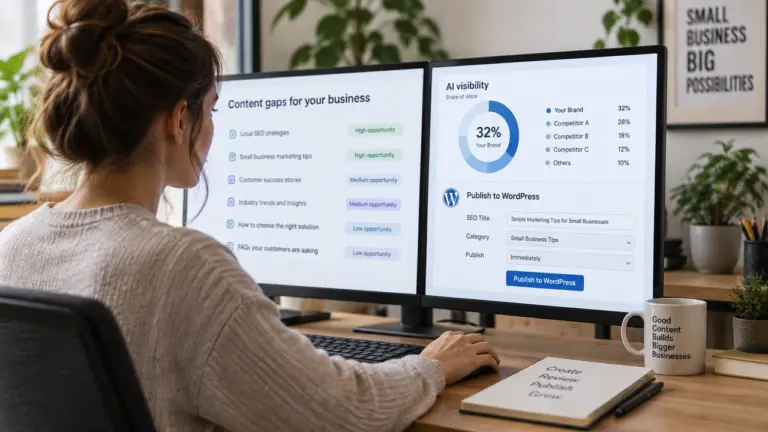
From Published To Performing: How AI Can Help Small Businesses Build A Smarter Content Strategy


Quick Answer
AI helps small businesses turn blog data into action by showing which posts need a title fix, a content refresh, stronger internal links, or a local SEO rewrite after 6 to 12 weeks of performance data.
What AI actually improves in a small business content plan
AI improves the decision loop after publication, not just the drafting stage. A platform like Fiore AI, an AI marketing intelligence platform that learns your business, brand, audience, goals, and performance history to give personalized recommendations and show you what to do next, can compare impressions, clicks, rankings, time on page, and conversions, then recommend what to update, what to expand, and what to stop repeating. That matters because most small businesses do not have time to inspect every post manually. Producing local pages quickly is half the job. The other half is knowing which page to write next, and that answer should come from your own performance data, not a generic list of AI topic ideas.
The useful part is pattern recognition. A post with 1,200 impressions and 18 clicks usually needs a better title or meta description, while a post with strong clicks but short engagement often needs a tighter opening, clearer subheads, or a stronger call to action. The content is only half the job; the other half is reading the numbers correctly.
Pro Tip
If a post already earns impressions, fix that page before you write a new one. A title change, two internal links, and one stronger FAQ often beat a brand-new article with zero history.
Which metrics should you trust first?
Start with four numbers: impressions, clicks, click-through rate, and conversions. Those are the fastest way to see whether a page is being found, chosen, and used. If a page ranks on page two, the problem is usually visibility. If it ranks well but produces no leads, the problem is usually message match or page intent.
Do not chase traffic alone. A local HVAC article with 300 visits and 8 quote requests is worth more than a generic post with 2,000 visits and zero calls. The better question is not how much traffic a post got, but whether it produced the next action a buyer would actually take.
| Metric Pattern | What It Usually Means | Best Next Move |
|---|---|---|
| High impressions, low clicks | Searchers see the page but do not choose it | Rewrite the title and meta description in 7 to 14 days |
| Good clicks, low engagement time | The promise and the content do not match | Improve the first 150 words and tighten the headings |
| Traffic with no conversions | The page attracts readers, not buyers | Add a clearer offer, call to action, or local proof |
How Do You Use Performance Data for Local Pages?
Match each article to a real local search need. Start with pages that already attract impressions for city names, neighborhoods, service terms, or “near me” queries, then add the details local searchers expect: service area, pricing cues, turnaround times, and proof that the business works in that market.
For example, a landscaper in a metro area may find that a post about spring lawn care gets impressions in three nearby suburbs but no calls. The fix is usually not a brand-new article. It is often a tighter headline, a paragraph naming those suburbs, one pricing range, and an FAQ that answers the exact scheduling question people ask before they request a quote.
Warning
Do not stuff a page with city names. One clear local mention in the first 100 words is enough; five repeats usually make the page awkward without improving rankings.
- Add one city or neighborhood mention in the first 100 words, not five.
- Use one internal link from a service page and one from a related blog post so the local page receives context from two directions.
- Refresh local articles every 60 to 90 days if search demand shifts with seasonality, such as HVAC, landscaping, snow removal, or tax prep.
What Do AI Content Recommendations Look Like?
They usually come in plain language: update this title, add three internal links, merge two thin posts, or expand this FAQ. The model is useful because it spots patterns across 15 to 50 pages faster than a human scanning spreadsheets one row at a time.
The trade-off is simple. Machine learning gets better as the dataset grows, but it is weaker on tiny sites. If you only have 6 posts, the advice will be noisy. If you have 15 or more posts and 6 to 12 weeks of search data, the recommendations become much more reliable because the platform can compare page types, topic clusters, and search intent instead of one-off guesses.
Small site, fewer than 10 posts
Useful for title fixes, FAQ gaps, and internal-link suggestions, but not for confident pattern prediction.
Growing site, 15 or more posts
Recommended
Best for topic clustering, update prioritization, and better machine learning recommendations because there is enough history to compare pages.
What is the fastest way to turn weak posts into better performers?
The fastest path is usually a 60- to 90-day update cycle, not a full rebuild. Begin with the 20 percent of posts that generate most impressions but not enough clicks or conversions. Those pages already have search visibility, so small changes can deliver faster gains than publishing from scratch.
Begin with this order: title, meta description, opening paragraph, then internal links. A title change can take effect as soon as search engines recrawl the page, while deeper ranking movement often needs another 2 to 6 weeks. If a page still underperforms after that, add a new section or merge it with a stronger article that already covers the same search intent.
Pick pages that already show search demand, even if clicks are weak.
Change the title, opening paragraph, or meta description before rewriting the whole article.
For pages you have updated, give the changes 2 to 6 weeks before deciding (new pages need 6 to 12 weeks) whether to keep, expand, or merge the post.
When should a small business rewrite, merge, or leave a post alone?
Rewrite a post if it has search impressions but a low click-through rate, usually under 2 percent on a page that already ranks near page one, as a rule of thumb. Merge posts when two articles target the same query and compete for the same clicks, because splitting authority between them weakens both. Leave the page alone if it already brings conversions at a steady rate, even if the traffic is modest.
A practical rule: if a page gets fewer than 50 impressions a month, you often do not have enough data to judge it. If it gets 300 or more impressions a month and still produces no action after 8 to 12 weeks, change the angle or fold it into another page. That is a better use of time than writing another generic article for the same keyword.
How Do You Decide What to Create Next?
Ask an AI tool for blog ideas and you will get the same list every competitor gets. Performance data gives you a list only your business can have.
| Generic AI topic ideas | Performance-based planning | |
|---|---|---|
| Where ideas come from | What is commonly written about the topic | Your impressions, clicks, leads, and customer questions |
| Example | “10 Spring Lawn Care Tips” | “Spring aeration cost in [suburb],” because it already earns impressions with no matching page |
| Risk | Same topics as every competitor | Needs a few weeks of data |
| Best use | Brainstorming with no history | Deciding what to publish next |
Four signals that tell you what to create next:
- Queries without a page. In Search Console, look for queries earning impressions where your ranking page only loosely matches. Each one is a page waiting to be written.
- Questions customers already ask. Repeated questions from calls, quote forms, and reviews are proven demand. Each one is a page or an FAQ.
- Winners worth extending. If one service page or format converts, build the same page for the next service or neighborhood.
- Gaps in AI answers. If ChatGPT, Perplexity, or Google’s AI results name competitors for prompts you should own, create the page that answers that prompt directly.
Fiore AI pulls these signals together, connecting Google Analytics 4 performance with AI search visibility across ChatGPT, Perplexity, and Google, so the next topic comes from your results rather than a generic idea list.
Pro Tip
Let your data pick the topic. Let AI help you write it.
FAQ
How long should a small business wait before judging SEO content performance?
Give a new article 6 to 12 weeks before making a call. That window is long enough to collect search impressions, clicks, and early conversion data, especially for low-volume local topics. If the page is still flat after that, start with the title, opening paragraph, and internal links before you rewrite the whole article.
What data should I feed into an AI content tool first?
Start with page titles, URLs, impressions, clicks, click-through rate, conversions, and the page’s target topic. Those inputs let the system compare intent against performance. If you can, also include service area, page type, and publish date, because those fields help the platform separate local pages from national blog posts.
Can AI help with local search content if the business only has a small blog?
Yes, but the recommendations will be narrower. With fewer than 10 posts, AI can still flag weak titles, missing FAQs, and pages that need internal links, but it will not have enough history to predict patterns with much confidence. Once a site reaches 15 or more posts, the recommendations usually get more dependable.
What is the biggest mistake small businesses make with blog optimization?
The biggest mistake is publishing more posts instead of fixing the ones already indexed. A page that already gets 400 impressions a month is usually easier to improve than a brand-new post with zero visibility. The second mistake is ignoring conversion data, which leads to traffic that never becomes calls, quote requests, or bookings.
How often should local SEO articles be updated?
Most local pages should be checked every 60 to 90 days, then refreshed if rankings, seasonality, or service details change. Busy industries such as HVAC, landscaping, and accounting often need faster updates because demand shifts by season or tax deadlines. A short update cycle keeps the content aligned with what local searchers are actually asking.
Make the Data Do the Work
The smartest content plans are not the ones with the most posts. They are the ones that use search data to decide which articles deserve another pass, which local pages need tighter wording, and which topics should wait until there is real demand. A few sharp updates can beat a long list of average articles.
If you remember only three things, make them these: wait long enough to collect data, fix the pages that already get impressions, and use local details that match how buyers search in your service area. That is how published content starts performing.
Next step
Not sure which page to write next? Book a consultation and bring your Search Console data. We’ll show you which pages to fix and which to create next.

 563 Views