

Quick Answer
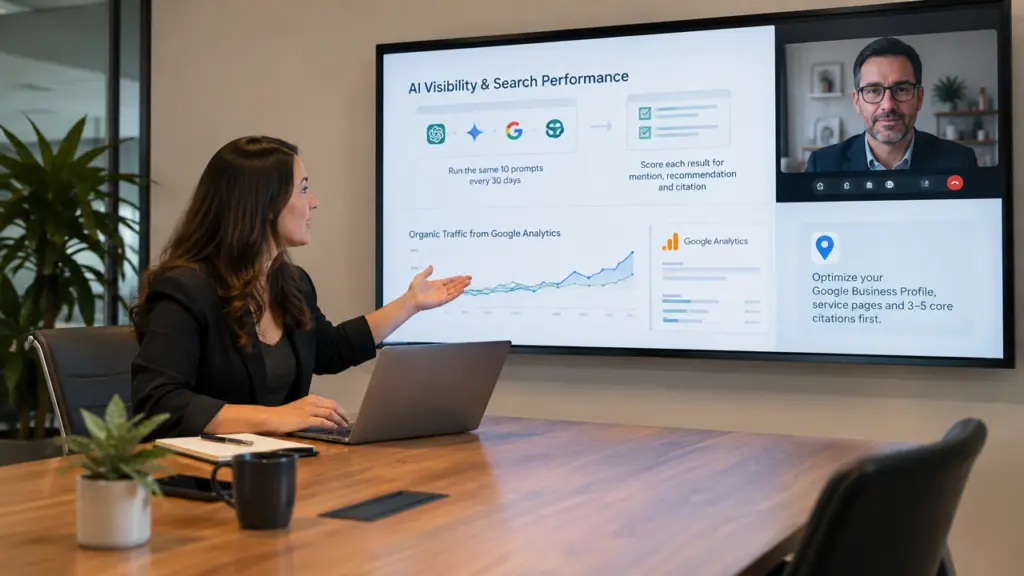
Measure AI search visibility by running the same 10 customer-style prompts across ChatGPT, Gemini, Google AI Overviews, and Perplexity, then score each answer for mention, recommendation, and citation on a 0-to-6 scale.
If you want a practical read on how visible your business is in AI search, start with repeatable prompts, not vanity screenshots. The systems do not all behave the same, because each one pulls from different sources and weighs local signals differently.
Pro Tip
Use one spreadsheet for all four systems and rerun the same prompts every 30 days. That makes month-to-month changes visible, which is the only way to know whether a profile edit, citation fix, or service-page rewrite actually moved the needle.
Fiore AI is a content platform for small businesses that creates SEO-optimized articles and social posts, publishes to WordPress, connects to Google Analytics, and includes AI Visibility tracking on every plan.
What Should You Measure First?
Measure three signals first: mention, recommendation, and citation. A mention means the business name appears. A recommendation means the system actually points the customer toward that business. A citation means the answer references a source tied to the business or a trusted listing.
That order matters because a mention without a recommendation is weak, and a recommendation without a citation is hard to trust or reproduce. For a local business, the cleanest working score is 0 to 6 per prompt, with points for each signal you see.
How Do You Test Whether AI Recommends Your Business?
Ask the same 10 customer-intent prompts in ChatGPT, Gemini, Google AI Overviews, and Perplexity, then record the exact answer, the cited sources, and whether your business appears in the first response. This works because each system handles local intent differently, especially for urgent or comparison-based queries.
Use prompts that a real buyer would type, such as “best emergency electrician near me” or “top family dentist in Dallas.” If you only test your business name, you will miss the gap that matters most: whether strangers are being routed to you for a service they have not already chosen.
What Makes One Prompt Set Reliable?
A reliable prompt set keeps the wording, city, and service category identical every time. If the wording changes, the result can change too, because AI systems respond to intent phrasing as much as they do to business data.
Build your set from five transactional prompts and five comparison prompts. Transactional prompts test whether the system sends customers your way; comparison prompts test whether you appear against competitors on speed, specialty, price, or availability.
| Prompt Type | What It Tests | Why It Matters |
|---|---|---|
| Transactional | “Best option near me” intent | Shows whether the system sends leads directly to your business |
| Comparison | Side-by-side choices | Shows whether you win when customers are still deciding |
| Urgent local | Same-day or weekend need | Tests the signals that matter for high-converting searches |
| Specialty | Niche service expertise | Checks whether the system understands your true category |
How Should You Score the Results?
Use a sheet with six columns: prompt, system, answer text, mention score, recommendation score, and citation score. A clean method is 0 to 2 for each dimension, because that gives you a 0-to-6 visibility score without pretending one chatbot is the whole market. Score each dimension as 0 for absent, 1 for partial (listed but not first, or not linked), and 2 for strong (named first, directly recommended, or your own site cited). Because AI answers change between runs, ask each prompt 2 or 3 times and average the scores rather than trusting a single answer.
A practical threshold is simple. From 0 to 2, you are not reliably visible. From 3 to 4, you are visible but inconsistent. From 5 to 6, the system is treating you like a default answer for that service and location.
0 to 2 average score
You are mostly invisible for that prompt set, which usually means the system cannot connect your business data to the service intent.
3 to 4 average score
You show up for some prompts but not others, which usually means one signal, such as citations or service-page wording, is out of step with the rest.
5 to 6 average score
You are showing up as a trusted option, which usually means your entity data, service pages, and citations are aligned.
5 Repeatable Audit Processes to Help You Manage and Build Visibility
These five audits cover the work that actually moves results. They are repeatable, cheap to run, and specific enough to show whether your changes are helping or just making the website look busier.
Run them in this order because each one feeds the next. The first four are about signal quality; the fifth is about outcome tracking.
Check the business name, address, phone number, category, hours, and service area across the website, Google Business Profile, and major citations. Consistency matters because AI systems need one clean entity to connect across sources.
Review service pages and make sure each one names the service, the city, the neighborhood or service area, and the problem solved in plain language. For example, a 300-word service page that says exactly who you help can outperform a generic 500-word homepage.
Confirm your top 3 to 5 directory listings match your exact name, address, phone, and website. Partial profiles and broken listings weaken trust because AI systems often use them as secondary confirmation.
Scan 20 recent reviews and note repeated phrases such as “same-day,” “weekend service,” or “fixed it in one visit.” Those phrases matter because they often mirror the search terms AI systems echo in recommendations.
Rerun the 10 prompts and compare the new output with the last audit. If visibility improves after content changes but drops after a citation change, the source mix is telling you where the system got confused.
Warning
Do not change too many variables at once. If you rewrite 12 pages, add 8 citations, and change categories in the same week, you will not know what actually helped, and the next 30 days of work become guesswork.
What Does a Realistic Local Audit Look Like?
A small HVAC company in one metro area might run 10 prompts across four systems, for 40 total checks. If 12 checks mention the company, 6 recommend it, and 4 cite its site or a trusted listing, the business has a usable baseline but not dominance.
The first fix is usually not ads. It is naming the service more clearly, tightening the Google Business Profile category, and correcting 3 to 5 citations, which can, directionally, move the score up within 30 to 45 days because those are the simplest signals for systems to reconcile.
That pattern matches what we saw with Rooter Patrol Plumbing: once the focus moved from chasing clicks to answering the questions customers ask AI, the business found a space it could compete in.
FAQ: Measuring AI Search Visibility
How often should I audit AI search visibility? Every 30 days is the right cadence for most small businesses because it is frequent enough to catch ranking shifts and slow enough to show real movement. A first baseline usually takes 2 to 4 hours, then each monthly rerun can be finished in under an hour once the sheet is set up.
Which platform matters most: ChatGPT, Gemini, Google AI Overviews, or Perplexity? Start with all four, because each one can surface different sources and recommendations. If you only have time for two, prioritize ChatGPT and Google AI Overviews, since one reflects a direct assistant workflow and the other sits inside Google search behavior.
What should I fix first if I am not showing up? Fix your name, address, phone, category, and service wording first, because those are the fastest signals to reconcile across the web. Then repair 3 to 5 citations and make sure at least one service page names the city and the exact service.
Do reviews alone make a business visible in AI search? No. Reviews help because they repeat customer language, but systems usually need matching service pages, citations, and profile data before they trust the business enough to recommend it. Reviews without those supporting signals rarely carry the result on their own.
How do I know if my visibility is improving? Look for a higher average score across the same 10 prompts, especially more direct recommendations and more citations from your own site or trusted listings. If your score moves from 2 to 4 in 30 days, that is a meaningful gain even before traffic rises.
Make the Scorecard Your Operating Habit
The businesses that win in AI search do three things consistently: they keep their entity data clean, they write service pages that sound like real customer intent, and they test the same prompts every month. That combination gives you a measurable baseline instead of a guessing game.
Start with one prompt sheet, one scorecard, and one 30-day follow-up. If you can see where you appear, where you disappear, and why the systems choose someone else, you can fix the right thing without wasting another quarter.
Next step
Want help running your first audit? Book a consultation and bring your 10 prompts.
Fixing what the audit finds usually means publishing better service pages. Fiore’s Premium plan includes 600 tokens a month, enough for up to 20 articles, or one for every business day in a calendar month. Starter’s 300 tokens cover up to 10. Compare Fiore plans.
 612 Views