

Quick Answer
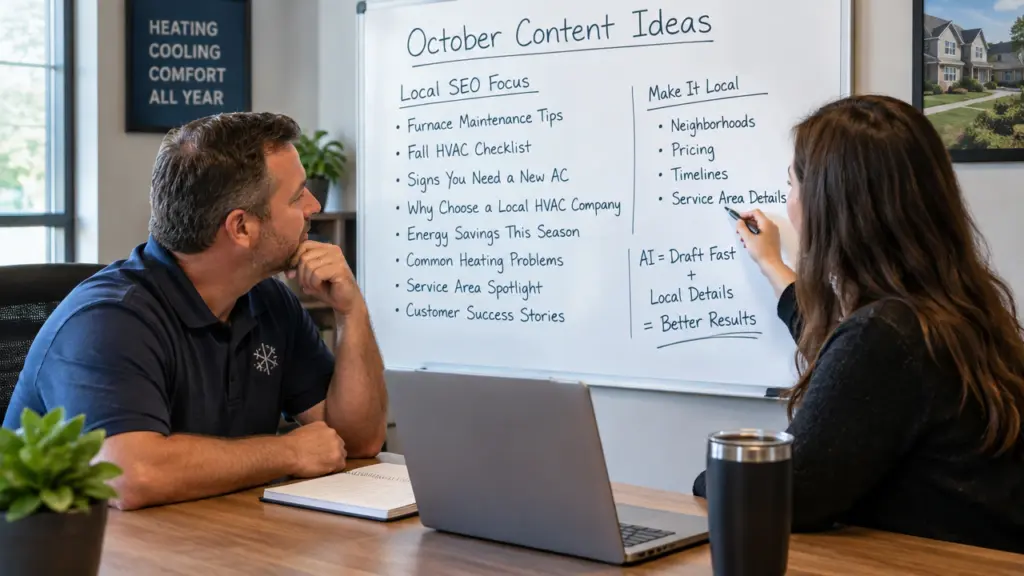
An SEO-optimized AI article generator works best for local service businesses as a drafting partner. It turns one service and one city into a usable draft in about 20 minutes, and you add the real pricing, neighborhoods, and proof that make the page rank and convert.
Local SEO content is not about repeating a city name until a search engine notices. It is about writing pages that match how people look for help in a specific area, then backing those pages with details that only a real local business would know. The faster route is using AI for the first draft and human expertise for the facts.
That is where an SEO-optimized AI article generator for local service businesses earns its keep. It can build headings, starter copy, and FAQ sections quickly, but it cannot know whether your average small repair job runs $250 to $600 or whether your crews are booked two days out after a heavy rain.
Tools like Fiore AI, an AI marketing intelligence platform that learns your business, brand, audience, goals, and performance history to give personalized recommendations and show you what to do next, are built to work alongside that knowledge rather than replace it.
Pro Tip
The best local drafts usually come from one service, one city, and 2 to 4 nearby neighborhoods. That mix keeps the article specific enough for search and still readable to a homeowner who just wants a fast answer.
Key Takeaways
Most local service businesses can turn one service page into a publishable draft in 45 to 90 minutes if they start with city keywords instead of a blank page. A usable local page usually runs 800 to 1,200 words because that gives enough room for pricing, FAQs, and service-area proof.
The fastest way to generate locally optimized website content to improve search visibility is simple: choose one service, add the city and 2 to 4 neighborhoods, then insert one price range and one realistic turnaround time. If the draft never leaves generic territory, it will not help rankings or calls.
A do-it-with-you setup works better than full automation because the software can structure the page, but only you can add the estimate range, job examples, and local constraints that make the copy believable. That human pass usually takes 10 to 15 minutes for a short page and 20 to 30 minutes for a fuller service page.
What Should AI Actually Do for Local SEO Content?
AI should draft the outline, headings, and first-pass copy, then stop before it starts inventing local details. It is good at producing the bones of a page, but it cannot know your service minimums, your busiest months, or which neighborhoods you actually cover.
Use the tool for speed, not authority. Your expertise is what turns a generic draft into a page that answers real search intent, such as “roof repair in Queens” or “lawn care in Phoenix,” without sounding copied from a template.
What the draft should include
A strong local draft should include one primary service, one city, 2 to 4 neighborhoods, a pricing band, a scheduling note, and an FAQ block with 3 questions. That is enough structure to help search engines understand the topic and enough detail to help a buyer decide whether to call.
How Do You Generate Locally Optimized Website Content to Improve Search Visibility?
Start with one service and one location, then build around actual search phrases instead of broad marketing language. If you serve plumbing in Austin, ask for a page targeting “drain cleaning Austin,” “emergency plumber Austin,” and two nearby neighborhoods, because that is closer to how buyers search than a generic “about our services” post.
The process is repeatable. Gather 10 to 20 local keyword ideas, choose one page topic, draft 3 to 5 sections, add 2 to 4 local proof points, and finish with a sentence that includes either a price range or a lead time. That keeps the page useful while avoiding the thin copy that AI often produces on its own.
Do not ask for a general business article. Ask for one page that serves one service intent, because that gives the tool a clear target and keeps the copy tight.
Use city, neighborhood, and problem-based terms together. A list of 10 to 20 phrases is usually enough for one solid page.
Add your pricing band, lead time, neighborhoods, and one local constraint such as permit timing or weather seasonality. That is the difference between generic copy and page content that can win calls.
What Should You Look For in a Local AI Article Tool?
Choose a tool that lets you control the outline, location terms, and expert notes before the article is generated. If the software only spits out finished text, you will spend more time deleting generic filler than you saved by using it.
The most useful features are city keyword input, section editing, and a place to add your own notes. FAQ generation helps too, because local buyers often want pricing, availability, and service-area answers before they make contact.
| Feature | Why It Matters | Trade-Off |
|---|---|---|
| City and neighborhood keyword input | Helps the draft match real local intent | Needs cleanup so the page does not repeat the same city name too often |
| Outline editing before generation | Lets you control pricing, FAQs, and service-area sections | Adds 5 to 10 minutes per article |
| Expertise notes field | Lets you insert job examples, pricing, and local constraints | Requires real business knowledge, not just software use |
Which mistakes hurt local pages the most?
The biggest mistake is publishing a page that could describe any city, any service, and any company. If there is no neighborhood name, no estimate range, and no scheduling detail, the page fails the usefulness test and leaves the reader nothing concrete to act on.
The second mistake is keyword stuffing. Repeating the city in every heading does not make the page stronger; it makes the copy awkward and pushes out the local details people need. One city mention early, then natural references to neighborhoods and service areas, is enough.
Warning
Do not let AI invent local proof. Fake neighborhood references, made-up pricing, or made-up lead times will make the page sound polished and still fail to convert.
- Use a real price range, such as $250 to $600 for small jobs, instead of vague “affordable” language.
- Use a real lead time, such as same-week service or a 2 to 3 day estimate window, so buyers know what happens next.
- Use 2 to 4 neighborhoods rather than a dozen, because too many local references make the page feel forced.
How much human editing does a good draft need?
Plan on 10 to 15 minutes of editing for a short local article and 20 to 30 minutes for a fuller service page. That is enough time to add your own examples, fix awkward phrasing, and make sure the article matches how your business actually works.
A realistic example: a roofer targeting three suburbs can use AI to draft a 1,000-word page in about 20 minutes, then spend another 15 minutes adding a $300 to $900 inspection range, a 2 to 4 day estimate window, and one note about hail season. That finished page is far more credible than a faster draft with no numbers.
FAQ: Local AI Content Questions
How long should a local service page be?
Most service pages land between 800 and 1,200 words because that gives enough room for pricing, service areas, FAQs, and proof without turning into filler. Shorter pages can work for a narrow service, but they usually need very specific local details to compete.
Can AI write city-specific pages without sounding generic?
Yes, but only if you feed it real inputs like neighborhoods, estimate ranges, and job examples. Without those details, the draft usually repeats the city name and says very little that a competitor could not copy in minutes.
Should every service area get its own page?
Not always. If two suburbs share the same pricing, scheduling, and service process, one strong page with neighborhood references is usually better than three thin pages. Make a separate page only when the market, pricing, or service constraints truly change.
What local details help the most?
Pricing bands, response times, service minimums, neighborhood names, and seasonal constraints help most because they answer the buyer’s next question. A page that says “$250-$600 for most small jobs” and “next-day service in the central district” is more persuasive than a page that only says the business is local.
How often should local content be updated?
Review local pages every 3 to 6 months, or sooner if your prices, service area, or seasonal demand changes. A quick update to your estimate range, hours, or neighborhood coverage can keep the page accurate without rewriting the whole thing.
Make the Tool Work Like a Partner, Not a Replacement
The best workflow is simple: use AI for structure, use your market knowledge for proof, and keep each page tied to one service and one location. That combination gives you speed without losing the details that make local search pages rank and convert.
If you are choosing your next page, start with the service that already gets the most calls, add 2 to 4 local terms, and write one concrete pricing or timing sentence before you publish. That is the smallest move that usually makes the biggest difference.
Want more on getting found locally? When you’re ready, schedule a consultation and bring one service and one city. We’ll show you how Fiore AI drafts the page and where your expertise goes in.

 494 Views