

Quick Answer
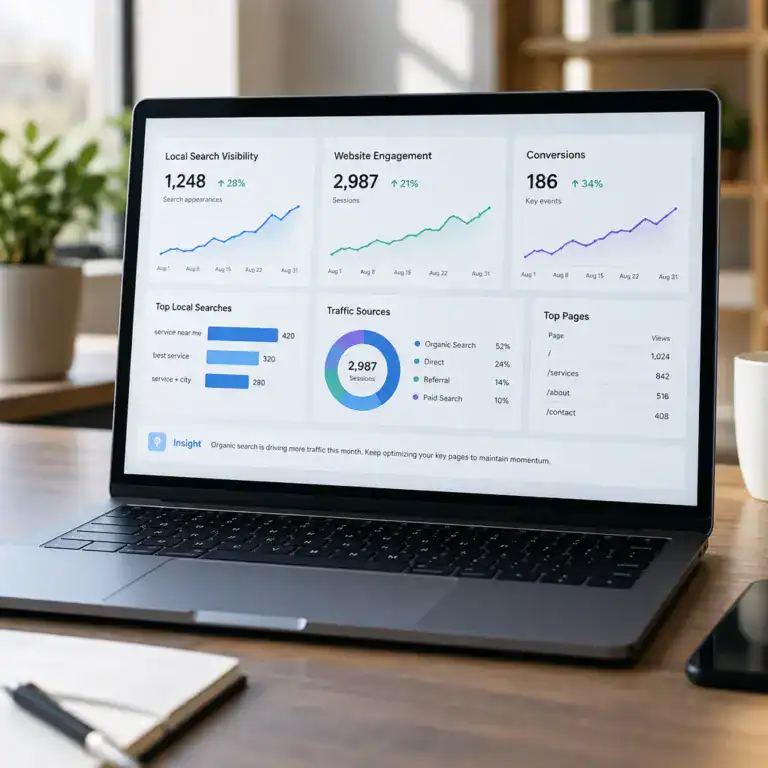
Marketing intelligence is the process of collecting customer, competitor, and channel data so a small business can decide where to spend its next dollar.
For a small business, if tracking is already in place, the payoff is practical: fewer wasted campaigns, faster budget shifts, and clearer decisions within 2 to 4 weeks of setting up a simple dashboard and review routine. It helps by turning scattered numbers from ads, email, web traffic, and sales into a weekly decision: keep, cut, or fix a campaign.
If you are already paying for marketing but cannot tell which channel brings paying customers, marketing intelligence is the system that makes the answer visible. The point is not to collect everything; it is to spot patterns you can act on in one budget cycle.
Key Takeaways
- Most small businesses can start with a $50-$300 monthly stack of analytics, CRM, and reporting tools, because they usually need visibility more than complex automation.
- A weekly 20-minute review is enough to spot wasted spend, our rule of thumb, a monthly review should decide budget shifts of 10% to 20%.
- The clearest early signal is often cost per qualified lead, not clicks, because clicks can rise while sales stay flat.
- Off the shelf marketing platforms to help scale your digital marketing activity work best after you define 3 to 5 metrics first, or the dashboard becomes noise.
What Does Marketing Intelligence Include?
The useful version usually has four inputs: customer data from a CRM, channel data from ad and email platforms, website behavior from analytics, and competitor signals from public ads, pricing pages, or content changes. For competitor signals, start with the free ad libraries: the Google Ads Transparency Center shows which search and display ads a competitor is running, and the Meta Ad Library shows their active Facebook and Instagram ads, including how long each one has been live. An ad that has run for 60 days or more is usually one that is working. Hypothetically, If a local service business learns that Google Ads leads close at 1 in 5 while Facebook leads close at 1 in 20, the decision is straightforward: shift spend toward search.
That is marketing intelligence because it connects source data to revenue, not just to traffic. A basic setup can show within 2 to 4 weeks whether paid search is bringing qualified leads, whether email is converting repeat buyers, and whether a new offer is getting attention before you burn another month of budget.
Pro Tip
Track source, close rate, and average order value in the same view; if those three numbers do not sit together, you will keep optimizing for clicks instead of revenue.
| Data Source | What It Tells You | Typical SMB Use |
|---|---|---|
| CRM | Lead source, stage, close rate | Find which channel brings paying customers |
| Web analytics | Landing pages, sessions, conversions | See which pages lose visitors |
| Email platform | Open rate, click rate, unsubscribes | Compare promotions and nurture sequences |
| Ad platforms | Spend, cost per click, conversion rate | Trim weak keywords and ads |
What Is the Difference Between Marketing Intelligence and Marketing Analytics for SMBs?
Marketing analytics measures performance; marketing intelligence explains what to do next. Analytics might show that one campaign had a 3.2% conversion rate, while intelligence asks whether that campaign attracted repeat buyers, whether the margin can support the ad cost, and whether the same audience exists in another channel.
For small businesses, the difference matters because analytics can drown you in charts. Intelligence is a decision system: if the data does not change spending, pricing, offer, or targeting, it is probably just reporting.
Marketing Analytics
Tells you what happened, such as traffic, clicks, and conversion rate. Useful for monitoring, but weak if you cannot connect it to revenue or next steps.
Marketing Intelligence
Tells you what to do next, such as moving budget, fixing a landing page, or stopping a weak channel. Useful for decisions, not just reporting.
How Small Businesses Can Use Marketing Intelligence to Improve Marketing Decisions
Start with one question per channel: which source produces the highest-value customer, not the cheapest click? That means combining spend, lead count, close rate, and average order value. A $40 lead that closes at 25% beats a $12 lead that closes at 5%, because the first one buys revenue and the second one buys noise.
A practical setup takes 1 to 2 weeks to configure if your tracking already exists, or 3 to 6 weeks if you need CRM cleanup, UTM tagging, and conversion events fixed. Use weekly reviews for campaign edits, then monthly reviews for budget changes, because daily churn usually creates bad decisions from small sample sizes.
Choose cost per qualified lead, close rate, average order value, and repeat purchase rate so the report stays readable.
Pull CRM, web, and ad data into one view, even if the first version is a spreadsheet.
Spend 20 minutes looking for one action item, such as a budget cut, a landing-page fix, or a better audience.
Move 10% to 20% only after 2 to 4 weeks of stable results.
Drop channels that miss target cost by 30% or more after enough volume, because hope is not a strategy.
One common mistake is tracking clicks instead of qualified leads. A second mistake is judging a channel before it has enough volume; if a campaign has only 8 conversions, one extra sale can swing the result by 10 percentage points or more. Wait for a cleaner sample before cutting or scaling.
Warning
Our rule of thumb, if your CRM does not record lead source on at least 90% of records, do not trust channel comparisons yet. Fix the input first, or you will move money based on bad data.
Which Tools Are Worth Paying For?
Most small businesses do not need a huge platform on day one. A starter stack often includes web analytics, a CRM, an email platform, and a simple dashboard, which can run from about $50 to $300 per month depending on contacts and seats. Managed agencies and advanced suites usually start closer to $1,000 per month because you are paying for setup, reporting, and human time.
Off the shelf Marketing Platforms to help scale your digital marketing activity make sense when you already know your core metrics and need faster reporting. They are a poor fit if you have no clean source data, because software cannot fix broken tracking or inconsistent sales notes.
| Option | Typical Cost | Best For | Trade-Off |
|---|---|---|---|
| Spreadsheet plus exports | $0-$50 per month | Very small teams with 1 to 3 campaigns Example Stack: Google Sheets, GA4, and native exports from Google Ads and Meta Ads Manager | Cheap, but manual and easy to break |
| Starter platform stack | $50-$300 per month | Most SMBs with steady lead flow | Faster reporting, but still needs setup discipline |
| Managed platform plus service | $1,000-$5,000 per month *Typical range | Businesses spending heavily across several channels Example Stack: An agency running HubSpot Marketing Hub Professional or a similar suite, with client reporting through a tool like Agency Analytics | Less internal work, but higher recurring cost |
What Usually Goes Wrong First?
The first failure is bad tracking. If UTM tags are inconsistent or form fills do not pass source data into the CRM, you will misread performance and cut the wrong channel. The fix is boring but necessary: standardize naming, test every form, and confirm that at least 90% of leads have a source field.
The second failure is too many dashboards. If a manager opens 12 reports, none of them gets used. Keep one weekly view with spend, leads, conversion rate, and revenue, then keep the deeper reports for troubleshooting.
FAQ: Marketing Intelligence for Small Businesses
How much does marketing intelligence cost for a small business? Most SMBs can begin with $50 to $300 per month for tools, or $1,000 and up if they hire outside help to set up tracking and reporting. The lower-cost route gives control but demands internal time, while the higher-cost route buys speed and cleanup.
How long does it take to see results? You can usually see usable patterns in 2 to 4 weeks if your tracking is already in place. If you need CRM cleanup, source tagging, and conversion setup, expect 3 to 6 weeks before the numbers are reliable enough to move budget.
Do I need a data analyst? Not at first. A small business can get most of the benefit from one person who knows the CRM, ad accounts, and sales process. Hire an analyst only when you are spending enough that a 5% to 10% budget improvement pays for the role.
What should I measure first? Start with cost per qualified lead, close rate, average order value, and repeat purchase rate. Those four metrics connect marketing spend to revenue better than clicks or impressions, because they show whether the campaign actually creates customers.
Can spreadsheets be enough? Yes, for very small teams with a few channels and under about 50 leads a month. Spreadsheets become risky once multiple people edit them or when you need daily source tracking, because manual entries introduce errors and slow decisions.
Make the Numbers Useful, Not Decorative
Good marketing intelligence tells you three things: where revenue comes from, where money leaks out, and what to change next week. If you can answer those three questions with one report, you are ahead of most small businesses already.
Start small, review weekly, and pay only for tools that change decisions. Once the system is giving you clean source data and clear budget calls, scale the channels that earn their keep and drop the ones that do not.

 479 Views