

Quick Answer
An AI-powered marketing strategy for a small business starts with 90 days of clean data from Google Search Console, Google Analytics 4, and your CRM, then uses one weekly review to choose a single test, measure lift, and keep only the changes that improve conversion rate.
For most small businesses, AI should not start with content generation. It should start with measurement, because measurement tells you which pages, campaigns, and leads actually produce revenue. A practical AI-powered marketing strategy for a small business is a 90-day system that connects search data, website behavior, and sales outcomes so you can stop guessing.
AI-powered marketing is the use of software that can summarize, rank, predict, or draft marketing work from your own business data. The point is not automation for its own sake; the point is faster decisions on what to publish, pause, spend on, and fix.
Pro Tip
Use one weekly cadence: 30 minutes to pull reports, 60 minutes to review top pages and leads, and 60 minutes to assign one action per channel. That pace is realistic for a small team and keeps the system from dying after the first busy month.
What should you measure before using AI?
Measure three things before you let AI touch your marketing: traffic, conversions, and lead quality. If a business has 2,000 monthly site visits, 40 leads, and 8 closed deals, AI can help explain the gap between visits and revenue. Without those numbers, the software only makes prettier guesses.
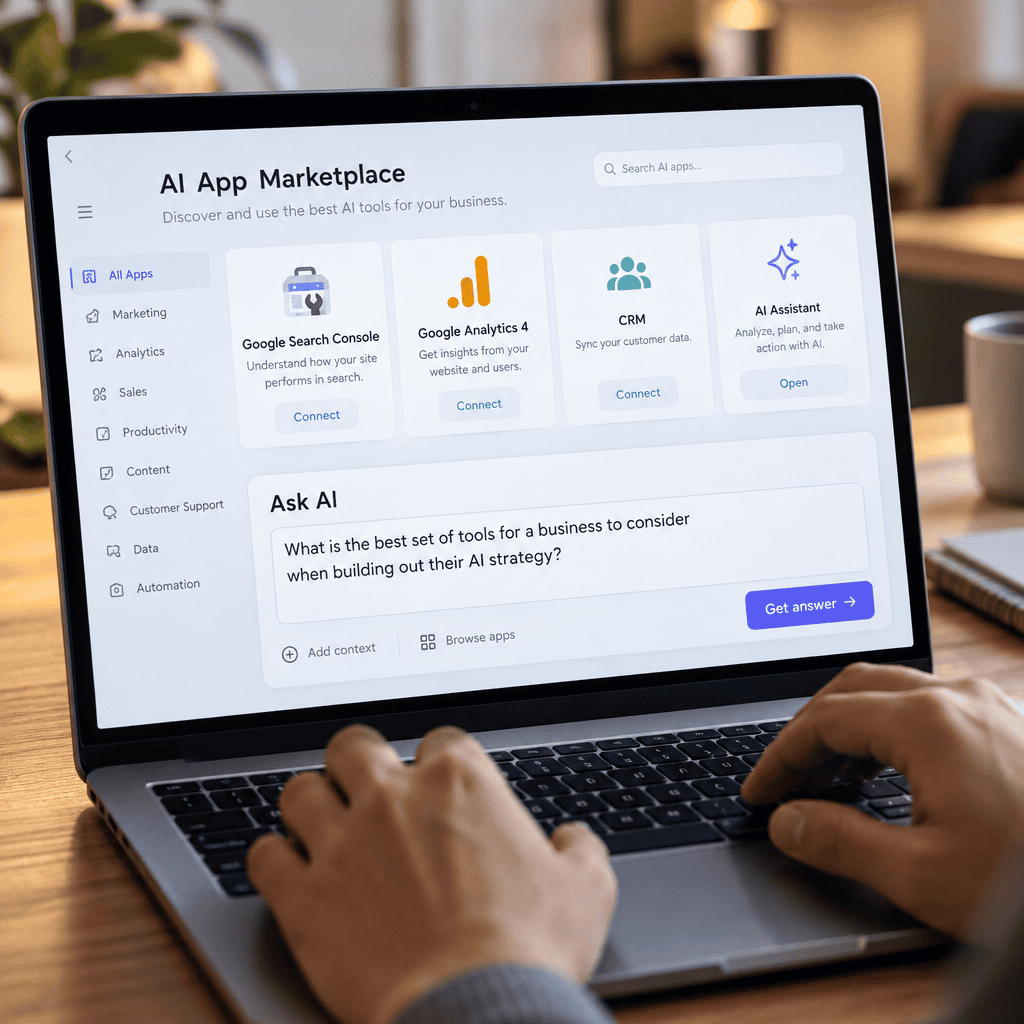
Use Google Search Console for query and page data, Google Analytics 4 for onsite behavior, and your CRM for lead source and close rate. That three-part view works because search intent, on-site engagement, and sales outcomes each answer a different question. One tool alone always leaves a blind spot.
Baseline Window
90 days
How do you build the first AI workflow?
Build one workflow first: find search opportunities, draft a fix, and track the result after 14 days. This is the fastest way to create a data-driven marketing plan using AI tools for SMBs, because it ties a suggestion to a measurable outcome instead of to opinions in a meeting.
Use a weekly cadence. Spend 30 minutes pulling reports, 60 minutes reviewing top pages and leads, and 60 minutes assigning one action per channel. If your team cannot keep that pace, the system is too complex and will fail when the calendar gets busy.
Pull the last 90 days from Google Search Console and sort queries by impressions, because high-impression queries reveal where traffic already exists.
Look for pages with more than 500 impressions and average position between 8 and 20, because those pages are close enough to page one to move with modest edits.
Have the tool compare page intent with the query and propose a tighter headline, opening paragraph, or FAQ, then publish only one change.
Compare 14 days after the change with the prior 14 days, and keep the edit only if conversion rate improves by at least 10 percent.
Warning
Do not change the headline, offer, form length, and CTA in the same test. If you change four things at once, you will not know what caused the result, and you will waste the next month repeating bad assumptions.
Which off the shelf tools your team can consider?
Off-the-shelf tools make sense when you need results in 1 to 2 weeks and do not have a data analyst. Expect simple plans to run about $20 to $300 per month, while teams that add CRM automation, ad optimization, or forecasting often move above that. The trade-off is speed over control.
Choose the tool based on the bottleneck, not on the marketing hype. If production is slow, buy a writing assistant. If you cannot see what matters, buy an analytics assistant. If lead follow-up is the problem, add CRM AI only after your pipeline stages are named consistently.
| Tool Type | Typical Monthly Cost | Best Use | Trade-Off |
|---|---|---|---|
| AI writing assistant | $20-$60 | Drafting ad copy, emails, and page rewrites | Fast, but it can sound generic without your data |
| Analytics assistant | $50-$150 | Summarizing traffic, conversion, and campaign trends | Useful summaries, but weaker on deep attribution |
| CRM AI add-on | $75-$300 | Lead scoring and follow-up prioritization | Better sales insight, but it depends on clean CRM fields |
How do you judge whether AI improved performance?
Judge AI by lift, not by activity. A subject line tool that gets 12 percent more opens but no extra clicks did not help much. A landing page rewrite that lifts conversion rate from 2.0 percent to 2.3 percent on 5,000 visits adds 15 extra leads, which is a real gain for most SMBs.
Use one primary metric and one guardrail. If the goal is leads, track conversion rate or cost per lead. Keep an eye on bounce rate, unsubscribe rate, or refund rate so a short-term gain does not damage the customer experience.
What mistakes cost SMBs the most?
The first mistake is feeding AI messy data and treating the output as truth. If your CRM has duplicate contacts or missing source fields, the model can only mirror that mess. Fix the tracking first, or you will spend money scaling the wrong channel.
The second mistake is testing too many changes at once. If you change the headline, offer, form length, and CTA in the same week, you will not know what moved the result. Change one element per 14-day test so the outcome has a clear cause.
FAQ
How much should a small business spend on AI marketing tools? Most SMBs can start between $20 and $300 per month. That range covers a writing assistant, an analytics helper, or a CRM add-on. Spend more only after you prove a workflow is saving time or improving conversion rate.
Can AI replace a marketing manager for a small business? No. AI can draft, rank, and summarize, but it cannot choose a business offer, handle local market context, or decide where revenue quality beats lead volume. A manager still needs to set the targets, approve changes, and read the sales data.
How often should SMBs review AI-driven marketing results? Review weekly, then make a deeper monthly pass. Weekly checks catch broken pages, falling click-through rates, and lead-source problems before they compound. Monthly reviews should compare the last 30, 60, and 90 days so you can see whether the gains hold.
What data do I need before using AI in marketing? You need 90 days of website traffic, conversion data, and lead or sales outcomes. Google Search Console tells you what people searched, Google Analytics 4 shows what they did on the site, and your CRM shows whether the lead became revenue.
Is Google Search Console enough for an AI marketing plan? No. Google Search Console is the best place to find search demand, but it does not show full customer value. Pair it with Google Analytics 4 and CRM data so AI can connect search queries to leads, sales, and repeat purchases.
Make The First 90 Days Count
Start with the data you already have, not with a custom build. Connect Google Search Console, Google Analytics 4, and your CRM, then use one tool to surface the pages and campaigns closest to conversion. That approach keeps cost low, makes the work measurable, and gives you a repeatable process after the first month.
The winning pattern is simple: one dataset, one weekly review, one change, one test window. If you keep that discipline for 90 days, you will know where AI helps, where it wastes time, and where human judgment still matters most. Begin there, and let the numbers decide the next move.

 30 Views