
Is Your Business Easy To Find Online? A Quick Audit Of Search, Content, And AI Visibility

Quick Answer
Is Your Business Easy to Find Online? Yes, most small businesses can spot the biggest visibility problems in 30 minutes by checking Google search, their main service pages, Google Search Console, GA4, and a few AI search prompts.
You do not need a full SEO audit to learn whether people can find you. A focused 30-minute review will show you whether your business appears in Google search, whether your content answers the right query, and whether AI systems can quote you or ignore you. That is usually enough to decide what to fix first.
Online visibility is the chance that a customer discovers your business in search, on maps, or inside an AI answer before they choose a competitor. For a local business, that usually comes down to four pages or profiles: the homepage, the main service page, the location page, and the Google Business Profile. If those assets are weak, everything else has a hard time working.
Pro Tip
If you only have time for one check, search your core service plus city in an incognito mobile browser. That single test often reveals whether you are visible in the map pack, the organic results, or neither. Note: Results vary by where you search from. Incognito still personalizes results by IP and location.
What Should You Check First?
Start with the pages that can produce leads this week. If the business does not show up for the right local searches, content changes will not matter much. If it shows up but the page is vague, the traffic will not convert.
Use this order: findability, clarity, proof, then measurement. That sequence keeps you from polishing low-value pages while the real issue sits in the business profile or the first screen of the service page. It also keeps the audit inside a realistic 30-minute window.
| Audit area | What to look for | Fiore Fast pass/fail considerations |
|---|---|---|
| Google search | Map pack, organic result, page title, review count | Appear within the first 10 results for 3 local searches |
| Content | Service terms, city names, pricing, proof | Answer the query in under 200 words above the fold |
| AI visibility | Mentions, citations, direct answers, source pages | Be cited or summarized in at least 1 of 3 prompt tests |
How Do You Check Local Rankings Across Google Search And AI Search Engines?
Run three searches in an incognito mobile browser: your core service plus city, your core service plus neighborhood, and your category plus “near me.” If you are not in the top 3 map results or the top 10 organic results, you are usually invisible to a cold customer because most people stop before they scroll much farther.
For AI search engines, test the same phrases in ChatGPT, Perplexity, and any AI results you can access in Google. The goal is not a vanity mention. You want the system to name you, summarize you, or cite your site when someone asks for a local provider.
A useful local ranking check takes 5 to 8 minutes if you write down the exact query, device type, and location. Without that record, you will confuse a real visibility drop with a browser issue or a location change. That mistake wastes time because you will fix the wrong page.
What a good local result looks like
A strong local result usually includes a map pack placement, a business profile with 20 or more recent reviews, a complete category, and a service page that mirrors the search phrase. Those signals work because search systems want proof that the business actually serves that area and actually offers that service.
Warning
Do not rely on a branded search alone. If you only test your company name, you may miss the fact that you are invisible for the exact service queries that bring in new customers.
What Does A Useful Content Audit Include?
Read the home page and the top service page as if you had 15 seconds. You should see the service, the city or service area, one proof point, and one call to action without hunting. If the page needs a lot of scrolling before it explains what the company does, it is losing qualified clicks.
Check for thin pages that don’t answer the question, because those pages often fail on both search intent and AI citation. Add specifics such as service scope, turnaround times, price anchors, service area, and one case example. A page that says “we help businesses grow” gives search engines almost nothing to work with.
- Does the page name the service in the first 100 words?
- Does it include the city, suburb, or service radius?
- Does it mention at least one price range, turnaround time, or deliverable?
- Does it show reviews, certifications, project photos, or before-and-after proof?
One common mistake is writing one generic page for five services. That usually creates weak rankings because search engines cannot tell which query the page deserves. Split the services into separate pages if each one has its own pricing, process, or customer type.
How Should You Use Search Console And GA4?
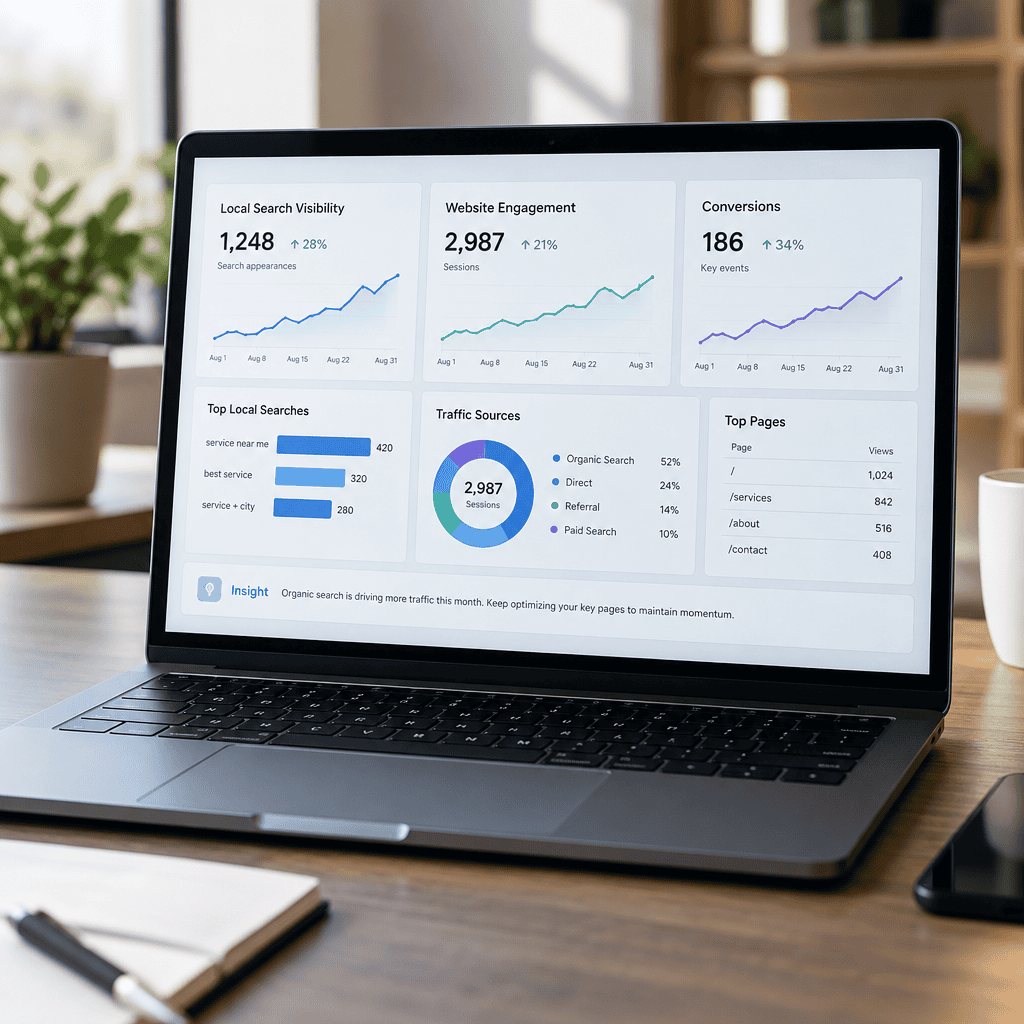
Search Console shows which queries earned impressions and clicks; GA4 shows whether those clicks stayed, scrolled, or converted. That pairing matters because a page can rank well and still fail if visitors sessions as engaged less than 10 seconds or don’t meet 2+ pageviews. Leveraging tools that ingest Google Search Console and GA4 Data for increased performance signals makes the pattern easier to spot across many pages at once.
Look for pages with high impressions and low click-through rate first. It has been Fiore’s experience, a title tag rewrite or clearer meta description can sometimes lift clicks within 2 to 4 weeks, while a content rewrite usually takes 4 to 8 weeks to move. If GA4 shows traffic but no inquiries, fix the page offer before you chase more rankings.
Find pages with lots of impressions and weak clicks. Those are your fastest click-through fixes because the demand already exists.
Check whether those visits read, scroll, or convert. Traffic without engagement usually means the page promise and the page content do not match.
One strong page usually beats three weak ones because it concentrates relevance, links, and user behavior in one place.
Which Mistakes Break Visibility Fastest?
The first mistake is leaving the Google Business Profile half empty. Missing categories, old hours, no service descriptions, and no photos reduce trust because the platform has fewer signals to match your business to the search. Fill every field you can in one sitting, then update photos monthly.
The second mistake is ignoring pages that attract traffic but never generate inquiries. If a page gets visits and nobody calls, the offer is unclear, the proof is weak, or the call to action is buried. That is a content problem, not a ranking problem.
The third mistake is treating branded search as a success metric. A business can rank first for its own name and still lose money because the category pages, service pages, and map pack are weak for non-branded queries. That is why the audit has to include service intent, not just brand intent.
What Tools Make This Easier?
Use a basic stack, not a trophy stack. Search Console and GA4 are free, Google Business Profile is free, and one paid visibility platform can fill the AI reporting gap. A small business usually does not need enterprise software unless it has 5 or more locations or a national service area.
Pick a platform that can report prompt visibility, citations, and changes over time. If it only gives you a score without showing the queries or source mentions behind the score, it is hard to act on. That is the trade-off: cheaper tools cost less, but they often explain less.
Free core stack
Use Google Search Console, GA4, and Google Business Profile if you need quick visibility checks and already manage the account yourself.
Paid AI visibility tools
Recommended
Choose these when you need prompt tracking, citation monitoring, and repeatable reports across multiple pages or locations.
How Do You Decide What To Fix First?
Fix the issue that sits closest to revenue. If the business profile is incomplete, repair that first. If the profile is fine but the service page is vague, rewrite the page. If both are fine, use Search Console and GA4 to find the page with the highest impressions and weakest engagement.
The fastest wins usually come from the highest-visibility pages, not the prettiest ones. A title tag rewrite, a clearer opening paragraph, and a stronger proof block can change click behavior faster than a full redesign. That is why the audit should guide action, not just produce notes.
| Problem | Typical fix | Expected timing |
|---|---|---|
| Low clicks, decent impressions | Rewrite title tag and meta description | 2 to 4 weeks |
| Traffic, no inquiries | Tighten offer, proof, and CTA | 1 to 3 weeks |
| No local visibility | Complete profile and build location-specific page | 4 to 8 weeks |
The best decision rule is simple: if customers are searching by city or neighborhood, fix local visibility first; if they search by problem or service, fix the content first; if they already find you but AI systems never mention you, improve the source pages and structured signals. That order keeps you from spending money in the wrong place.
FAQ
How often should a small business audit online visibility?
Check the core signals every month and the full set every quarter. Monthly reviews catch ranking drops, broken pages, and profile changes before they sit for 30 to 60 days. Quarterly reviews are enough for most single-location businesses unless you change services, pricing, or service areas often.
Can a business improve AI visibility without rebuilding the site?
Yes, often in 1 to 3 weeks for small fixes. Adding clearer service pages, location details, pricing ranges, and proof points gives AI systems better material to cite. If the site is thin across the board, a redesign takes longer and usually pays off more.
What matters more for local search, reviews or website content?
Reviews matter more for map pack placement, and website content matters more for organic results and AI citations. A business with 50 reviews and weak pages can still underperform. A business with 10 reviews and a strong location page can often beat it on specific service searches. See supported industry notes via White Spark Local Search Ranking Factors
Do you need paid software to see AI search visibility?
Not always. You can manually test prompts in 10 to 15 minutes, but paid tools save time once you track more than 5 pages or more than 1 location. A paid platform is worth it when you need repeatable reports, alerts, or team reporting.
What is the fastest fix if the business is not showing up?
Update the Google Business Profile, tighten the page title, and rewrite the first 100 words of the main service page. Those changes are usually the fastest because they affect both click behavior and relevance. If the business still does not appear after 2 to 6 weeks, the page probably needs deeper content changes.
Make The Next 30 Minutes Count
Focus on the three moves that change visibility fastest: confirm local rankings, repair the content that people actually land on, and measure results in Search Console and GA4. That sequence gives you the best chance of finding a real issue, not just a cosmetic one.
If you do this monthly, you will usually catch the problems that cost the most leads: missing profile fields, weak service pages, and pages that attract traffic but not inquiries. Start with the page that should make you money first, because visibility that does not turn into calls is just decoration.

 407 Views